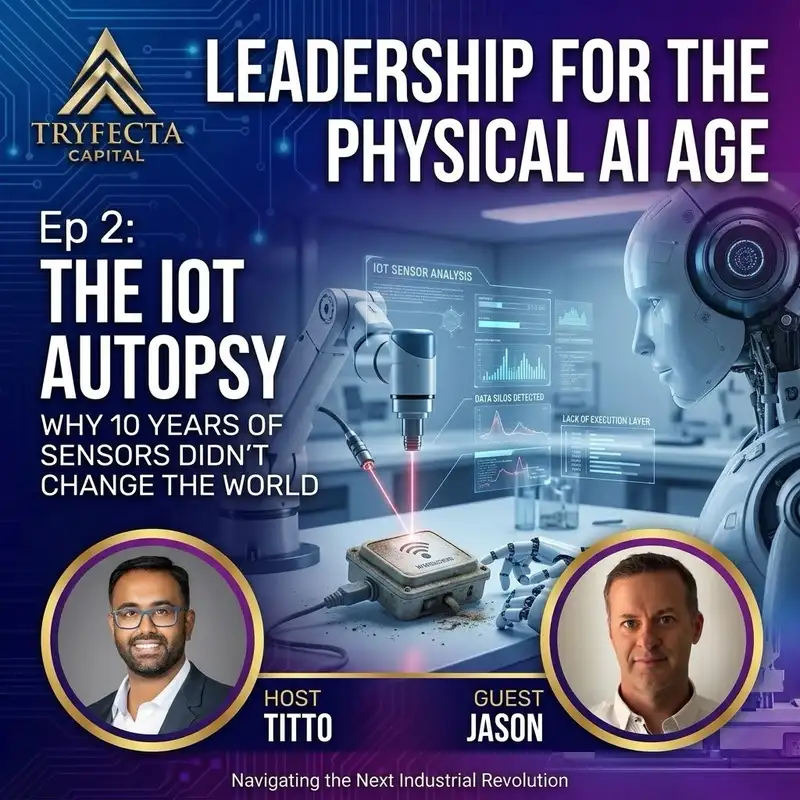
Ep 2: The IoT Autopsy: Why 10 Years of Sensors Didn't Change the World
Download MP3And we are live. Welcome to the Leadership in the Age of Physical AI presented by Triphoter Capital. We have our first guest, Jason Kwareberg. There you go. Great to have
Jason:you on. Thanks, Tito.
Titto:And I have a controversial question for you. The autopsy of IoT. Is IoT dead, Jason?
Jason:Right. Yeah. Let's get into that. I'm not sure if autopsy is the right word that that I would approach at this time. Autopsy means, as you said, death.
Jason:I don't think IoT is dead. I think it's just part of an overall journey that it's happening and we're in the pathway now. So if I reflect back to around the 2012, 2013, there was a tremendous amount of hype around IoT It was gonna change everything. There was gonna be smart buildings, smart cars, smart factories, you name it.
Titto:Smart dumpsters?
Jason:Everything. Yes. In fact, yeah, we've seen smart dumpsters. We've seen some pretty innovative things and they're useful. I think what's happened is there's a few challenges that have occurred as part of that, right?
Jason:So, it certainly was overhyped that we're going to have this magical connected world. You know, really what I saw occurring was that connectivity was not as easy as it was made to be, particularly in factories and industrial settings, getting connectivity underway is not quite so simple. Some things that we did observe, right, are that the ubiquity of the sensors, Well, that did actually manifest. And so, for me, I'm kind of looking backwards and saying, well, what held it back? For me, it's all around context.
Jason:All of these individual sensors and applications that were born, they were born to do siloed things. Businesses don't need siloed things done. They need siloed things done in context, in coordination with others. So, what do mean by that? I don't need just a predictive analytics solution that only runs on this particular pump.
Jason:I need a predictive analytics solution that runs on everything that I have, brings it up, and helps me shorten, compress the sense, fuse, react kind of timeline that we've talked about previously. Not so much a false start. I think it's we built a lot of the good foundation that needs to be there. But, businesses expected more. Business expected that connected context across those applications.
Jason:So, if, for example, a vendor came to them and said, have a wonderful condition monitoring widget. Fantastic. I love it. How does it work with everything else? The vendor is going, well, it doesn't.
Jason:This is the value that it brings. Isn't it obvious? And even when those value cycles are, you know, value opportunities are are really high and enormous in and of themselves. They were they were shut down because they didn't operate in in in the hole. Didn't operate for the business.
Titto:Got it. Got it. I mean, I can basically talk for myself. A lot of these a lot of these sort of IoT projects have just made consume consumables more expensive. Well, you know, it's had a $2 lamp, and that's now become a $20 lamp, because it's got a because it's got a 50¢ Wi Fi chip in it.
Titto:So same thing for industries because, a lot of the projects I've seen, it's been quite frustrating for upper management because they said, oh, yeah. We need, we need to do this because it's there's a business reason behind it. And we'll spend millions in each of these divisions trying to connect everything up, putting sensors on everything. And, you know, I talk to most of the execs, and you find mixed reactions. Some would say, yeah.
Titto:We've seen value out of it. Some would say, we've spent a lot of money. I don't even know what's happened. How do you do that? And there were people listening to this podcast with a bad taste in their mouth.
Titto:They'd say that, listen. I mean, we've we've tried this before. We try to put try to make mechanical things smart. It just doesn't work.
Jason:Let's see. I think, you know, what comes to mind as you bring that topic up is the concept of lean. And so for years, we have leaned our factories, and we have leaned the staff that are supporting those factories. Right? And so, when there's this massive moment of innovation that we want to apply to the factory and to our operation, well, who's left to do it?
Jason:The folks that run the factory are there to run the factory. That's it. The innovation that had come before the age of IoT was always very point meal, tested, and it's a really simple type of thing that goes in and affects one small part of the operation. Getting IoT right and getting real value out of IoT requires this concerted effort over time to connect the stack from the sensors, from the raw sensing, right up to the decision support that they enable. So, a business really needs to understand that connected decision chain.
Jason:What decisions do they wanna make? What are the right decisions that should be enabled by IoT? And how do I start small and have the stomach and the energy to to invest in scale? And it takes me right back to Lean. I don't think has set the right environment for that type of innovation that's required for this, you know, broader investment.
Titto:No. You're touching no because, you know, because this podcast is mainly for senior leaders, that Lean's been brilliant because it's actually broadened a lot of savings. Right? And it's not something that so look at it from the original Japanese concepts where, for example, in 2008, the GFC, it's destroyed factories and industries because one of the concepts of lean, which is just a time, has bankrupted companies. But at the same time, most execs will be quite happy with the way that you're talking about.
Titto:So you're talking about something tangible, you can see the cost savings there. There's been an x percentage in reduction in overall cost. I've been able to get my products out faster, cheaper. And that is something that I'm I'm sure would be hard to get out of any any of the corporation's hands. You'd have to pry it from their cold, dead hands.
Titto:And when we are basically touching something as sacred as that, you know, you you we talk about sacred cows. This is one of the sacred cows.
Jason:I think so. I think the ideal thing was give me the easy button for IoT. And, there's there's not really an easy button. And, for me, it's a really simple acceptance point is, have you ever been in a factory and walked around the factory or or a drilling platform or an oil and gas rig. Have you ever walked around one and then visited a second one and taken the same pathway?
Jason:Never. Right? Yeah. But, never the same. So, the idea that I have a solution that's meant to fit into my world precisely as it ships from the manufacturer of the software, it was a false hope.
Jason:It's never going to happen. I kind of look at that as also perhaps it's an expectation around the IoT that it was maybe some of the vendors set too high of an expectations. Maybe the leaders had too high of an expectation of what should be achieved just by turning the thing on. It also speaks to an overwhelming availability of choice in the market. So I have high end platforms that purport to do the entire stack, but their price of entry is very high, right down to DIY types of solutions where the only price of entry is literally the cost of knowledge, knowing how to do it.
Jason:And again, you know, businesses are gonna struggle with this, right, is I need to see the value to make the all in investment, and it's not been there. I need to spare the time to build a small prototype that is scalable, but my people are running lean. So, I'm as we as we step back a little bit, and the whole topic, the question you launched in here is, What's the autopsy of IoT? This is just where we are today, and I think these are the forces that are driving businesses and their appetite and the pace at which they invest in IoT. But, you know, to me, this is a point in the journey.
Jason:Here, we'll the term, you know, the fourth industrial revolution or whatever. Right? We're just in the midst of it. So, when I talk about this idea of context, AI is gonna bring that context. AI is gonna help me figure out, I need to wire the predictive maintenance application to the condition monitoring to the playbook, to the run time to the operational order that I'm building at that time, then take decision over that.
Jason:That's really hard for people to build and connect all those dots. But AI can look at it and say, I see what you're trying to do here. Bang, there's the connection and I don't need to worry about being on one stack anymore. AI, guess what? It can also figure out, I know what you're dealing with over here.
Jason:I know what this signal is. I know why we need this signal. So, I think it's just that we've spent IoT decade building the foundation. Perhaps the slides were right after all. The missing element was that we didn't have the appropriate depth of AI built at that time.
Jason:And here we are.
Titto:So, you know, just summarizing what you're saying, we were just missing an ingredient. Were basically baking a cake without the topping.
Jason:That's a good way to put it. Absolutely. The good news is all the ingredients are still in the bowl. So we haven't thrown out the batch. We've just, got this final ingredient, the icing on the cake, let's say, to pull the analogy further, that we hadn't had till now.
Titto:Yeah. That's a, yeah, that's a great one. So so really the AI is the icing on the cake. If so if AI is the icing on the cake, so what can we expect? You know?
Titto:I mean, I I know we, you know, talked to some of the people who are quite disappointed, and maybe we've got people who've been listening to this who are quite happy with what's happened in IoT. But, you know, come across my experience rather is a mixed bag of and a lot of people basically saying this is just a failed it's a failed thing, and nobody wants to talk about IoT. But in this age of physical AI and especially with this podcast focusing on the leadership aspects of it, because the fundamental concept of this is that we're looking at leadership to build and drive physical AI world. So my question to you then is, what can we expect as leaders, as executives, sort of people running businesses? What's next?
Titto:Where are we headed? It's a very Yes. In in the context of I've invested billions into this plant. I don't want to out the cables. Right?
Jason:That's right. And, in some ways, just because we have the the last ingredient in the cake, we still have to take the energy to to bake it and, mix it and, you know, and do all those things. And some of the topics that we covered previously around lean and the appetite and the capacity for the businesses to to integrate these things. If you add to that some of the skepticism that has emerged over AI as AI was coming on to the market and it was growing and learning, there is certainly a lot of fear around concepts like hallucination and concepts like security and and so forth. And in an operational setting, those are certainly gonna be still on the minds of all the individuals.
Jason:But I think the leaders are gonna move past that. The leaders are gonna see the opportunity, which is that for all the dozen odd failed IoT experiments, they didn't fail because they were inherently bad. They failed because they didn't connect themselves to enough value to sustain themselves, kind of like a flywheel analogy. Right? I need to put some energy into the flywheel to get it moving.
Jason:But once that energy is there, keeping it moving and expanding, it's a lot easier. We could talk static kinetic energy or, you know, whatever. But we still have to overcome that. But I think what happens is just as you probably use AI in your day to day life for administers, administerial tasks, helps you write better, think better, etcetera. Just take that same paradigm and put it exactly in those, in the hands of those people running those those pilots, they're connecting to the decision much faster.
Jason:They're connecting with the information that they have much faster. They're not wasting their time in applications trying to figure out, well, how do I wire this signal up to that one? That's not where the value is. The value is shortening this sense, fuse, react sort of timeline and and and that's that's what we can expect from AI. And and I believe it's yeah.
Jason:It's it's like we said, it's it's the attitude that businesses will take. The leaders are gonna compress on that paradigm as quickly as they can, and they're gonna find ways to scale that paradigm rapidly.
Titto:Right. So where where does that leave us? Right? So let's let's sort of take that to the balance sheet. Let's take the other balance sheet or let's take that to the business side of things.
Titto:Are we basically looking at are we gonna change the top line, or are we gonna change our bottom line, or are we gonna do both?
Jason:Look. In my mind, the IoT investments that we've seen in facilities have always been about the bottom line. They've always been around what are the costs? How do I how do I avoid cost? How do I avoid downtime?
Jason:How do I increase the OEE? Like, these are all the use cases. How do I do predictive maintenance so I make sure that I have stock on hand and I have the team that's trained and we learn them all and everybody converges on a solution and the line is up and running. That's largely where the space of IoT has been. And probably the other use case there, when we looked at IoT, we saw two dominant use cases in industry.
Jason:One is in the operations and the other is out in the field and services. So, in supplying and performing services services to existing plan or existing product. And and again, it's just fusing the information to the individual to make those decisions faster. But in both in both settings, they're about cost. There's still not the the idea of differentiating the product offering is I think still still lagging where the focus has gotta be on on the bottom line, on the cost side of the equation.
Titto:And then is that is that like a a low hanging fruit, easy to get, and AI is just gonna accelerate that cost savings? Or are we gonna see any change in the top line trying to expand services? Is there an echo? So I I suppose the question is that, say, IT is not dead. We're getting the icing on the cake.
Titto:We're just missing the icing on the cake. It was this dry cake that nobody had the mark to ingest. And now that we have icing on the cake and people want it, and it's going to be mass adopted. Other than just a so we're basically going back to lean. We're be going back to lean because we're looking at trying to save money here.
Titto:Because end of the late day, if you look at the original meaning of of lean, it comes from the Japanese word, which basically means produce waste. So that's what lean really is. It could be a waste of time. It could be a waste of, you know, man hours. It could be a waste of resources, people, whatever.
Titto:So you look at looking at it from that concept, we're still looking at, hey. I'm gonna use IoT to reduce waste because how that translates into efficiency to the operational efficiency, whatever. We mentioned kind of so the fact that there's there's there's potentially once IoT is mass adopted, is there is there a function where AI can actually supercharge it and it can actually make things scalable?
Jason:100%. That that's that's the argument for it.
Titto:And that's that's where the top line that's where the where it impacts the top line. Right? So you're basically looking at, hey. You know, business. So, Abhi, the question really is gonna be businesses that now adopt IoT in its version two with with AI on board.
Titto:Are they are they gonna have a competitive edge with other businesses who may not be able to scale that division as well as this company, which has an IoT framework and that can expand their solution or their business or their operation or, you know, what
Jason:are the 100%. You know, what what if you look at any operating setting, there is a ton of information that you can derive. And part of that, what we did with early IoT was a bit of a learning curve. We could get a thousand parameters coming off of some piece of kit in the factory. Wow.
Jason:A thousand different parameters on what this one thing is doing. What value is there? What does it lead to? So the faster that I can decide what information that I need, so IoT has made that information readily available. So I've got tons of it.
Jason:Tons of data, historical data, just PI systems are filled to the brim with all this data. Sensing that and making it into rapid decision support systems, even decision support systems that come up on the fly. There is this problem. I don't know how to solve it. AI buddy, tell me how to get my plant back online as fast as possible.
Jason:Right? You've been in those circumstances. You fly the team in, the team, assembles. They're looking at the maintenance manual. The maintenance manual doesn't match what's in front of them.
Jason:The signals that they're reading off of the asset don't match what the dashboard is saying. All of this is a little bit askew. The AI can deal with these types of things, right? So, but again, you know, some of the points that you raise still remain is that this isn't a magic pill, right? It can do some wonderful things, but the program that the business has needs to be put in place so that it can sponsor, incubate, nurture this type of experimentation and scale it in a controllable way.
Jason:What if we took this magic pill analogy and we went nuts with it, right, and we just said sprinkle it everywhere? Who would be in control?
Titto:I mean, and just conscious of time as well. We just have nine minutes left in this podcast, so I know there's a lot to talk about it. I mean, I think I think what he appoints or basically saying, look. I mean, we IoT is all set for a big, big, big comeback, and that's gonna be the differentiator between businesses that adopt IoT in its sort of version two versus businesses who haven't adopted it. Now tell me this.
Titto:Like, so businesses who are sort of, you know, it's you know you you know, the the saying, it's better to have loved and lost in it and than rather than not having loved at all. Is this a case of companies who have had experience implementing in any way, good way or bad way, and learning that experience around IoT? Are they gonna are they going to be any better off than, you you know, companies who are just gonna gonna come into this absolutely fresh, probably have to even explain to them what IoT is?
Jason:That's a great question. And I think I think time will tell. But there are often times where certain technologies come in and early adopters are on the cutting, bleeding edge. And they either continue to take that stance, and so they lean into it and their people learn and they evolve and they follow this development in time. Or they are literally cut by it, burned by it, and say, Woah, not again.
Jason:I need to take a different stance in my adoption of technology. And still others who, as you said, haven't joined the dots at all. So, I think that unless you are just, you know, foot to the floor in terms of your bleeding edge, then you're likely to have taken some type of retraction, some type of you have made your approach more conservative in the wake of the experience that you had with IoT. So, you're less inclined to lean in. Now, we contrast that to a business who has never gone through that and what is available today and what they know that they can do by their interface with ChatGPT.
Jason:And they just say, wait a minute, let me just, you know, they have that moment, let me connect this on the factory. They may just skip all of that pain altogether and be in a position where they can move a lot faster because they don't have to deal with the learning curve of how do I connect my sensor and how do I wire it to the pie and how do I do all these things, they might be much better experienced. And that experience, the positivity of that experience will keep that needle of the organization set where it needs to be in terms of their approach to investment. And I believe they would even be a bit more open to moving the needle a little bit more in the forward position towards an innovative stance.
Titto:Also, don't, you know, continuing on that point, talk to the small and medium businesses. What's the sort of financial slash commercial formula they need to follow, you know, coming into this convergence? Are they should they move now? Should they wait for a bit? What's a what's a good commercial strategy for us, especially for small and medium business?
Titto:We know that the large Yeah. Businesses can Yeah. That's a
Jason:very tough one. You know, the small and medium businesses have their strengths and their agility. And and so they can compete and move in markets where the the larger organizations cannot. AI can potentially close that gap. So there's a risk for the for the small and medium business
Titto:what we call it. Right? AI is the great equalizer. So you've got a large businesses. Do you see one of the small business or medium business basically taking on one of the big boys and winning?
Titto:And so is that possible? Is that a thing, or is it still years away?
Jason:Yeah. It absolutely is. I I think the challenge that we see right now physically at this moment in AI and and physical AI itself is AI is performing wonderfully on our desktops. We can ask it any question. It will tell us a fantastic answer, we're just amazed by how it fuses the information together.
Jason:We're no longer skeptical of the information that it fuses together. Like, we're generally it's doing a good job. We do, however, have to translate that into an industrial setting. Now, the advantage we have in the industrial setting let's think about this. If we used all the words that you and I spoke during this podcast, they are not definitive.
Jason:They are subjective, they are interpreted, etcetera and each human is going to take away the different meaning from the words that we've spoken. Numbers and data that are existing from IoT and sensors and so forth don't have that. It's just raw data. It's a value. So, in fact, my argument would be that dealing with physical AI in a factory setting or something like that is actually a much safer play than it would be in asking your desktop, What should I do when I'm having chest pains?
Titto:Right. Absolutely. I think there's probably a better, easier use case on the factory floor than replacing your current doctor.
Jason:Yeah, absolutely. Yes. Well, and less at stake too, right? So, again, all of this has to do with the right incremental investment. But we used to say it's a pace.
Jason:I must continue to move. I must continue to move. I can't stop and stagnate and reflect on why that was a risk or whatever. I've just got to have that appetite to bear it.
Titto:They call it the red queen principle. So if you stay where you are, someone else is bound to get ahead of you and you become irrelevant. And so now with the pace of things, I mean, it's, it's, it's quite prolific with how things are moving at the moment. That it's honestly little bit of motion sickness, I think, for a lot of people, how fast AI because AI is building AI now. So it makes it extremely difficult to keep up with, hey.
Titto:You know, I I I'm gonna bed. I'm gonna wake up, and everything's just changed.
Jason:Yeah. That's right. And it makes it harder for you to assess exactly where should I jump in, but guess what? You should jump in.
Titto:Yeah. Absolutely. Yeah. You're either in the river or you're not. So and that's a great point to kind of wind down.
Titto:We just have two minutes left, but that's a great place to wind down. Like, either you are in or you're out. And that's I think that's a good context. So and I think sort of summarizing this, it's it's pretty clear that we've got a second wave of IoT coming as well as part of the physical AI, and that's gonna be critical. The whole sense of fusion and the sensor umbrella really is gonna be absolutely critical for us to kind of get into that whole wave of physical AI.
Titto:So getting those sensors right is gonna be critical. And and it's not just, hey, there's gonna be two big companies working on that. It's something that impacts, you know, the little guys. And the guys who get in actually have an edge, you know, like coming back to AI is the great equalizer. So whether you're big or small, rich or poor, if you know how to use AI properly, you you will just have the edge.
Titto:And it's not just a local market anymore. It might probably be a global market. Do you agree with that?
Jason:I I think that's the that's the nominal some some are as bold in the in the circles that we run-in, and they they literally say software development is dead.
Titto:Right. Yeah. Well, I mean, just with what, you know, what what AI can do today, I mean, you know, I could I could make a phrase today, and someone could listen to this podcast in a year and and think of you know, I I I might as well be talking during the time of the dinosaurs. So, let's keep the podcast relevant, and we won't sort of get into it. But it it seems like, you know, I mean, the next generation of kids would be probably asking, well, what's what's software development, Eddie?
Titto:Anyway, on that note, yeah, thanks for
Jason:coming been great discussion. Absolutely.
Titto:Absolutely. I wish we could keep going because it's such an interesting topic, but we are gonna keep continuing about a lot of the peripheral aspects and some of the key core technologies that will bring on the face of physical AI. And, obviously, AI does have some interesting There's lot back. There's a lot will need to be fixed. That that that's evidently, that's gonna be interesting.
Titto:A lot of development, a lot of new technologies, a lot of core technologies, a lot of peripheral work that needs to be done where we can say we are in this new age of physical AI. Like, five years ago, we thought the age of AI was a 100 ago. You know, it's gonna be in a 100. But thank you so much for your time, Jason, and really appreciate you coming on and sharing your thoughts. And see you for the next one.
Jason:Absolutely. Cheers, kid. Take care.
Creators and Guests