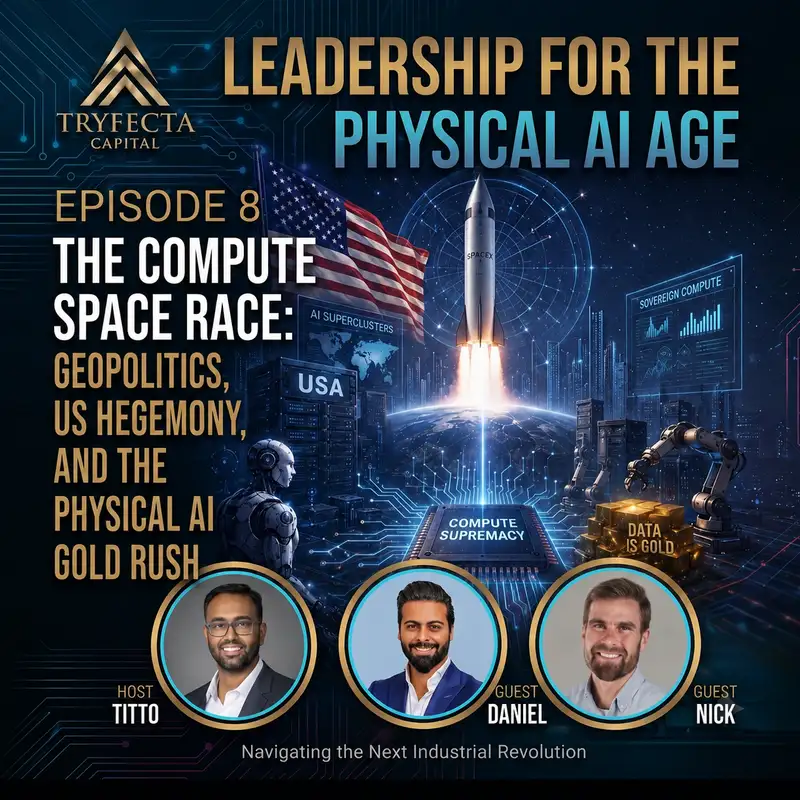
Ep 8: The Compute Space Race: Geopolitics, US Hegemony, and the Physical AI Gold Rush
Download MP3How does a baby learn faster than an LLM? Not by reading more text, but by touching the world.
That analogy from Daniel Dangoor (Investments and Treasury) anchors this episode's thesis: language models are capped by the finite supply of human text, and the next leap in AI depends on machines that can sense the physical world. Host Titto Thomas, Daniel Dangoor, and Nick Shelton unpack why sensors, not chatbots or humanoid robots, are the underserved gold rush of Physical AI.
In this episode:
Physical AI is bigger than humanoid robots and driverless cars. From rig sensors at Shell that optimized an entire fleet, to in situ soil analysis that maps rare earth deposits in a day instead of 3 months.
The compute space race. Dan's macro thesis on why the US treats AI as a race it must win at any cost, and why that makes the compute investment supercycle effectively unlimited.
Why sensors are the new Nvidia trade. Sensor stocks lagged every AI basket for 18 months, then rallied 80% between April and June 2026 as real industrial demand, not speculative hype, finally arrived.
The ethical scaffolding. Drawing on their backgrounds in theology and philosophy, the panel asks whether governance is mature enough for the productivity and geopolitical stress ahead.
Solving humanity's dirty jobs. Why machines should handle the 12 hour pipe inspections in the desert so people never have to.
The takeaway: language is only the beginning. The industrial economy needs AI that can feel, and capital is now shifting to build the sensors that make that fusion possible.
That analogy from Daniel Dangoor (Investments and Treasury) anchors this episode's thesis: language models are capped by the finite supply of human text, and the next leap in AI depends on machines that can sense the physical world. Host Titto Thomas, Daniel Dangoor, and Nick Shelton unpack why sensors, not chatbots or humanoid robots, are the underserved gold rush of Physical AI.
In this episode:
Physical AI is bigger than humanoid robots and driverless cars. From rig sensors at Shell that optimized an entire fleet, to in situ soil analysis that maps rare earth deposits in a day instead of 3 months.
The compute space race. Dan's macro thesis on why the US treats AI as a race it must win at any cost, and why that makes the compute investment supercycle effectively unlimited.
Why sensors are the new Nvidia trade. Sensor stocks lagged every AI basket for 18 months, then rallied 80% between April and June 2026 as real industrial demand, not speculative hype, finally arrived.
The ethical scaffolding. Drawing on their backgrounds in theology and philosophy, the panel asks whether governance is mature enough for the productivity and geopolitical stress ahead.
Solving humanity's dirty jobs. Why machines should handle the 12 hour pipe inspections in the desert so people never have to.
The takeaway: language is only the beginning. The industrial economy needs AI that can feel, and capital is now shifting to build the sensors that make that fusion possible.
Creators and Guests
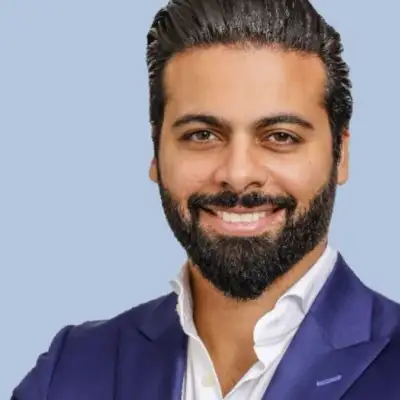
Guest
Daniel Dangoor
Daniel Dangoor is an experienced financial professional including as head of Macro Thematic trading at Goldman Sachs . His extensive career spans over 15 years in asset management and trading, featuring leadership and portfolio management roles across major global financial hubs:Goldman Sachs (London): Head of Macro Thematic Trading (April 2025 – June 2026) SPX Capital (London): Senior Portfolio Manager (December 2023 – March 2025) Brevan Howard (London): Senior Portfolio Manager (March 2019 – December 2023) Bradesco Asset Management (São Paulo): Portfolio Manager (August 2010 – March 2019) Prior to his career in finance, Daniel built a strong quantitative foundation in Brazil. He studied Mechanical Engineering at Universidade Presbiteriana Mackenzie from 2006 to 2010, where he was an active member of the Propulsion Engine Team. He also completed the International Baccalaureate program at St. Paul's School in São Paulo, with high-level focuses in Mathematics, Physics, Chemistry, and Business.